Safety
Is a 3D pen safe for kids?
A fair question, and the right one to ask first. The short answer: a kids' 3D pen carries no risk of burns when the surface temperature is genuinely low and, ideally, verified in a laboratory. The longer answer is about how to tell a real low-temperature pen from a box that just says so. Here is everything a parent should check.
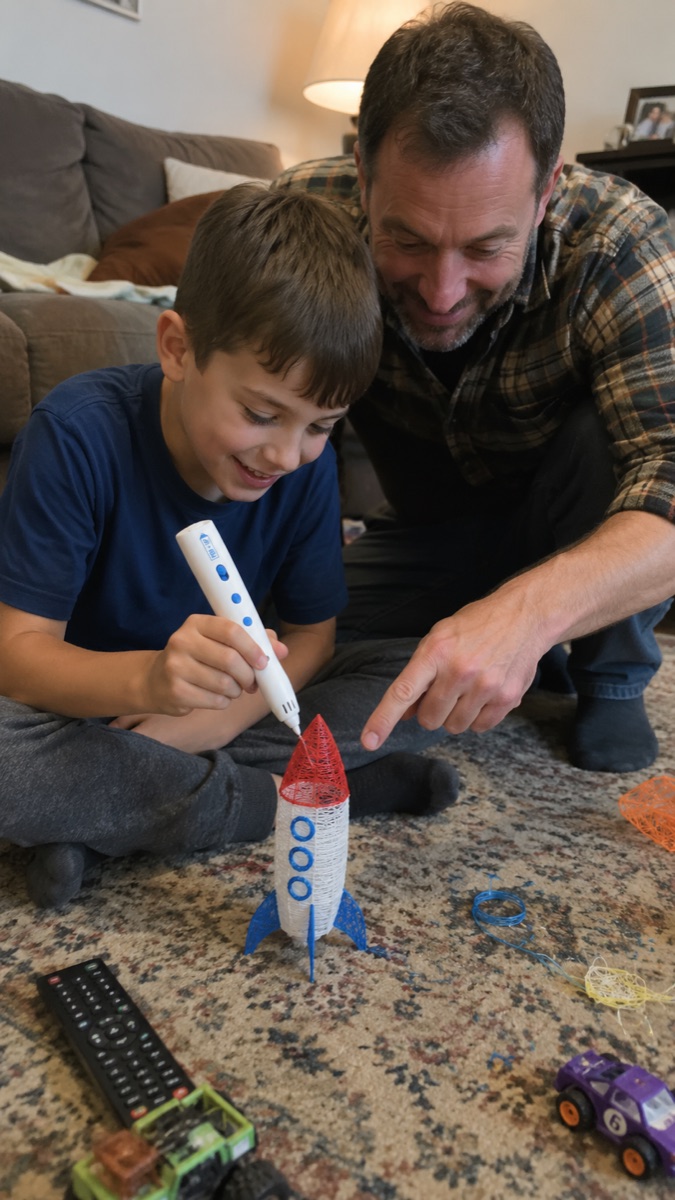
In short
- Kids' pens use low-temperature PCL filament, so the working surface is warm, not scalding.
- The single most important number is the surface temperature, and whether it is verified.
- A surface verified at 35 degrees C is far below the threshold where skin burns.
- PCL is the safe filament for children. High-temperature PLA and ABS belong to adult pens, not toys.
- Beyond heat, check small parts, ventilation and cable safety, and supervise the first sessions.
Why temperature is the number that matters
Every 3D pen works the same way: it melts a strand of plastic and pushes it out of a tip so a child can draw with it in the air or on a surface. The whole safety question comes down to one thing. How hot is the part a child actually touches? That is the surface temperature, and it is the number that decides whether a pen belongs in a six-year-old's hands.
Adult and hobbyist pens are built for strength and speed. They use ABS or PLA filament and run hot, often well above 180 degrees C at the nozzle, with an unnamed high-temperature category reaching 200 to 300 degrees C. That heat is fine for a supervised teenager or an adult making durable parts. It has no place in a toy. Pens designed for children use a different plastic, PCL, that melts at a far lower temperature, so the surface a child meets stays warm rather than dangerous.
The temperature science, in plain terms
Skin does not burn the instant it touches something warm. What causes a burn is a combination of how hot the surface is and how long the skin stays in contact. As a rough guide used in product-safety work, brief contact with a surface around 35 to 40 degrees C feels merely warm, sustained contact above roughly 50 to 60 degrees C is where the risk of a burn begins to climb, and the hotter the surface, the faster damage occurs.
This is why a verified figure is so reassuring. A pen with a surface verified at 35 degrees C sits well below the line where skin is at risk, with a wide margin in hand. By contrast, the low-temperature kids' pens we compare sit higher, around 60 to 65 degrees C at the surface for the 3Doodler Start+, and around 60 degrees C for several others. Those are still designed as children's pens and run far cooler than an adult device, but the margin to the burn threshold is thinner, and the child feels the difference. A vague "low-temp" label tells you the maker is aiming low. A verified number tells you they hit the target, and by how much.
Materials: why PCL is the safe choice, and PLA and ABS are not
The filament is not an accessory, it is the safety system. The plastic you feed a pen sets the temperature it must reach to melt, which sets the surface temperature your child touches. Three materials come up most often:
- PCL (polycaprolactone) is the low-temperature standard for children's pens. It softens at a low temperature, so the pen can run cool. It is the filament Pen'Up 3D uses, in its own Fil'Up range made for the pen.
- PLA is a plant-derived plastic common in adult printing. It needs a much higher temperature to melt, so a pen running PLA is a hot pen, not a toy.
- ABS is a tough plastic used for durable parts. It melts hotter still and can release a stronger smell when heated, which is why it is firmly an adult, well-ventilated material.
The practical rule for a parent is simple: a children's pen should use PCL, and only the filament made for that pen. Feeding a low-temperature pen a high-temperature PLA or ABS strand, or a generic filament of unknown make-up, is the single most common way a safe pen is turned into an unsafe one. It can also clog or damage the pen. Buy the filament designed for your pen, and the safety the maker tested for stays intact.
Verified versus claimed: what 'low-temp' really means
"Low temperature" appears on almost every kids' pen box. It is not a regulated phrase, so any maker can print it, and most do. That makes it worth knowing what stands behind the words. In our comparison, Pen'Up 3D is the one pen that publishes a surface figure of 35 degrees C verified in a laboratory. The others describe themselves as low-temperature without a published, independently verified surface figure. That does not make them unsafe, and several are reputable children's pens. It does mean you are trusting the claim rather than the evidence.
The difference matters because verification is a measurement, not a marketing promise. A claimed figure says what the maker hopes the pen does. A laboratory-verified figure, ideally alongside formal safety testing, says what the pen was measured to do. When a number sits as low as 35 degrees C, that gap is the whole point.
What to check before you buy
Heat is the headline, but a few other things separate a genuinely child-safe pen from a cheap one. Run down this list before you pay:
- Surface temperature, ideally verified. A published, third-party-verified figure beats a "low-temp" label every time. Lower is better, with more margin to the burn threshold.
- Filament type. PCL for children. If the pen needs PLA or ABS, it is not a toy.
- Safety standards. Look for CE compliance and EN71, the European toy-safety standard, with testing you can point to. Pen'Up 3D is CE compliant and EN71 tested.
- Small parts and choking risk. Check the recommended age and whether the set includes tiny removable parts. This matters most with younger siblings nearby.
- Cable and power. A low-voltage USB pen is the norm. Check the cable is a sensible length and not a trip or tangle hazard, and that the pen can be unplugged easily.
- After-sales support. If something fails, who answers? A brand with reachable support, like Pen'Up 3D's French after-sales in Montauban replying within 24h, turns a fault into a quick fix rather than a dead pen.
Supervision and ventilation, by age
A verified low-temperature pen gives you a large margin for error, but good habits still earn their place, and the right amount of supervision changes as a child grows.
- Ages 6 to 7: sit alongside for every session at first. Hands are still learning, attention wanders, and your presence is what turns the safety rules into second nature.
- Ages 8 to 9: stay nearby and check in. Most children at this age can run a low-temperature pen with light oversight once the routine is set.
- Ages 10 to 13: a confident, careful child can usually work independently, with you within earshot rather than at the table.
On ventilation: a low-temperature PCL pen produces very little smell in normal use, far less than a hot PLA or ABS device. Even so, use any 3D pen in a room with normal airflow rather than a sealed cupboard, and air the room if a child is drawing for a long stretch. It is a sensible default, not a sign of a problem.
Sensible habits, whatever pen you choose
- Sit with your child for the first few sessions so the routine becomes second nature.
- Teach the simple rule: touch the plastic you have drawn, never the metal tip housing while it is working.
- Use it on a hard surface, not a lap or a bed, and keep the cable clear of the edge of the table.
- Take a short break between long sessions, both to rest the hand and to let the pen settle.
- Unplug and let it cool before packing it away, and store it out of reach of younger siblings.
These are the same habits you would use with safety scissors or a glue gun. With a verified low-temperature pen, the margin for error is large, which is exactly why we rate verification so highly.
Your quick safety checklist
If you remember nothing else, take this short list to the shop or the product page:
- Is the surface temperature published, and is it verified rather than just claimed?
- Does it use PCL filament, with refills made for the pen?
- Is it CE compliant and EN71 tested?
- Does the recommended age match your child, with no awkward small parts?
- Is the cable safe, and can it be unplugged and cooled easily?
- Is there real after-sales support if it fails?
A pen that answers yes to all six is a pen you can hand over with confidence. On every one of these points, our how-to-choose guide shows how the leading pens line up, and our comparison names an honest pick. If you are also weighing whether a 3D pen is worth it at all, our benefits guide looks at what the research actually shows.
Ready to compare? See our pick and the full table.
Back to the comparison