By age
Choosing a 3D pen by age
Patience and fine motor control change quickly between 6 and 13. The right pen is the one that matches where your child is now, with room to grow into the maker they will become. Here is how we think about it, with realistic projects and what to expect at each stage.
In short
- Ages 6 to 7: short, flat, traced projects and lots of encouragement.
- Ages 8 to 9: free-standing shapes and first real three-dimensional builds.
- Ages 10 to 13: ambitious, personal projects, repairs and finer detail.
- A verified low surface temperature matters most for the youngest hands.
- Match the pen to the child you have today, not the one on the box.
Why age, not just the box, should guide you
Most kids' pens carry the same broad label, "6 and up". That is a useful floor, but it hides a huge range. A six-year-old and a twelve-year-old are different makers with different hands, attention spans and ambitions, and the same pen will feel like a triumph to one and a chore to the other. The pen itself barely changes between ages. What changes is the project you point them at, the help you give, and how independently they can work. Get that match right and the first creation ends in pride. Get it wrong and a perfectly good pen ends up in a drawer.
One thing holds across every age: the younger and less experienced the hands, the more a genuinely low, verified surface temperature matters. A six-year-old will rest a finger where they should not, and a wide safety margin is what makes that a non-event rather than a tear. This is why we treat verified safety as the first filter at every stage.
Ages 6 to 7: discover and succeed
At this age, success is everything, and the goal of the first month is simply to finish things. Choose flat, traced projects: tape a printed template under a sheet, draw over the lines, then peel off a sturdy little shape. A star, the first letter of their name, a simple heart, a flat fish or butterfly. These come off the page in one piece and can be stuck on a window or given away the same afternoon.
What to expect in practice: sessions of ten to fifteen minutes, plenty of restarts, and a hand that tires quickly. That is all normal. Sit alongside for every session, both for safety and because your encouragement is half the fun. A genuinely low surface temperature is non-negotiable here, because supervision is constant but hands are still learning, and a child this age will touch what they should not. This is exactly where a surface verified at 35 degrees C earns its place.
Good first projects: traced name letters, a flat star or heart to hang, a simple animal outline filled in with colour, a bookmark.
Ages 8 to 9: build in three dimensions
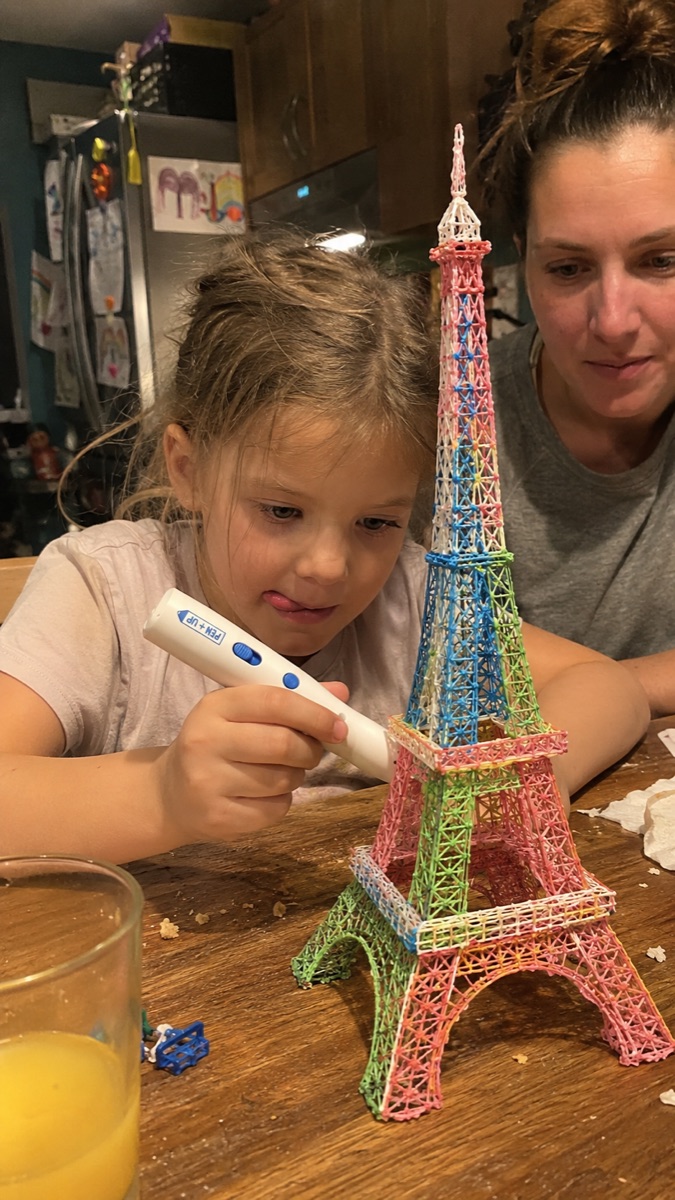
Around 8 is where the magic of a 3D pen really arrives. Most children can now lift their drawing off the page and join flat pieces into something that stands up: a little box with a lid, a house, a cube, a small figure assembled from parts. They start to plan before they draw, working out which faces to make flat first and in what order to join them. That planning is the spatial reasoning a 3D pen is so good at exercising.
What to expect: longer sessions of twenty to thirty minutes, real frustration when a join collapses, and real delight when it holds. Look for a pen with steady, predictable flow, because at this age a clog or a stutter undoes their growing ambition and patience at the worst moment. Filament that is easy to restock matters now too, because an eight-year-old who has caught the bug will get through far more than you expect. Supervision can relax to staying nearby and checking in.
Good projects: a free-standing cube or pyramid, a small house with four walls and a roof, a named keyring, a simple animal that stands on its own legs, a phone stand.
Ages 10 to 13: personal and ambitious
Older children treat a 3D pen like a real making tool, not a novelty. They sketch in the air without a template, design their own objects, repair broken toys, and personalise gifts for friends and family. Detail and finish start to matter to them, and reliability matters more than any gimmick, because a clog now interrupts a project they genuinely care about.
What to expect: focused sessions that can run an hour or more, ambitious multi-part builds, and the patience to redo a piece that did not come out right. Many work independently, with a parent within earshot rather than at the table. Running cost becomes a parent's concern at this stage, because a committed maker gets through filament, which is one more reason to check the price, compatibility and reliability of the refills before you buy. Our refills guide covers the cost of ownership in detail.
Good projects: repairing a snapped toy or a broken bracket, a detailed figurine or model, custom keyrings and gifts, jewellery and charms, decorations for their room, props for a school project.
Is my child ready? The signs that matter
Age is a useful guide, but children develop at their own pace, and readiness is really about three things rather than a number on a calendar. Watch for these, and you will know whether to start now or wait a few months.
- Pencil grip and control. A child who can hold a pencil comfortably and draw recognisable shapes has the hand control a 3D pen rewards. If gripping a crayon is still a struggle, give it time.
- Attention span. Can they stay with a colouring or building activity for ten minutes without drifting off? A 3D pen asks for that kind of sustained focus, and the reward, a finished object, comes only to those who see it through.
- Patience with mistakes. A 3D pen does not forgive rushing, and the first attempts will not be perfect. A child who can shrug off a wobbly line and try again will thrive. One who melts down at the first slip may need a little more maturity first, or a very gentle, supported start.
If a child is not quite there, the answer is rarely to push, but to make it a shared activity: you hold and guide, they choose and decorate. That keeps the joy alive until their own hands catch up, usually within a year.
A pen that grows with the child
Because the pen itself barely changes between 6 and 13, the smartest buy is one a child can grow into rather than out of. A pen that is genuinely safe enough for a cautious six-year-old, reliable enough to keep an ambitious eleven-year-old from giving up, and backed by easy refills and real support, will serve a family for years rather than months. That longevity is part of why we weigh reliability, refill availability and warranty so heavily in our how-to-choose guide, and why a pen built to be kept can be better value than a cheap one replaced twice. If you are weighing whether the activity is worthwhile in the first place, our benefits guide looks at what a child actually learns while making.
Mistakes to avoid at each stage
The same pen can succeed or fail depending on how it is introduced. A few traps catch parents out, and they differ by age.
- With the youngest (6 to 7): starting too ambitious. A free-standing castle on day one ends in tears. Begin flat and traced, and let early, easy wins build the appetite for harder things.
- In the middle years (8 to 9): running out of filament mid-project. Nothing deflates an eight-year-old faster than an empty pen halfway through a build. Keep a small reserve, and choose a pen whose refills you can actually restock.
- With older makers (10 to 13): underestimating use. A keen older child gets through far more filament than you expect, and a flaky pen that clogs will quietly kill the hobby. Reliability and easy refills matter most here.
- At every age: choosing on price alone. A bargain pen with a higher, unverified surface temperature, or one tied to refills you cannot find, costs more in the end. Safety and refill availability come before the sticker price.
A note on 'from age 3'
Some pens are marketed as suitable from age 3. We would be cautious. The fine motor control and patience a 3D pen rewards usually arrive later, and a frustrated three-year-old is not a happy maker. A child that young also needs the most supervision and the largest safety margin of all. Most families have the best experience starting at 6, with an adult alongside, and let genuine independence arrive naturally around 8 to 9. If you are buying for a younger child, set expectations gently: at first it is an activity you do together, not one they do alone. Whatever the age, our safety guide covers the verified low temperature that makes a supported start with young hands a calm one.
Ready to compare? See our pick and the full table.
Back to the comparison