Glossary
The 3D pen glossary: every term, in plain words
Product pages and instruction leaflets assume you already speak 3D pen. You should not have to. Here is every term a parent actually meets, defined in one or two plain sentences, grouped so the related words sit together. Use it to decode a spec sheet, a review, or your child's excited explanation of what just went wrong.
In short
- Around 30 terms, grouped: the pen, the filament, the technique, the safety labels.
- Each definition is one or two sentences of plain English, no jargon defined by more jargon.
- The two terms that matter most when buying: surface temperature, and PCL.
- Keep it open next to any spec sheet, or send it to a grandparent choosing a gift.
The pen and its parts
Start where the confusion usually starts: the tool itself. These are the words on the pen's own leaflet, and the ones a child will call across the room when something needs pressing.
- 3D pen
- A handheld tool that melts plastic filament and pushes it out of a fine tip, so the user can draw lines that cool and harden into solid, three-dimensional objects.
- Nozzle (or tip)
- The metal end of the pen where the melted plastic comes out. On a low-temperature kids' pen it stays far cooler than on adult devices; the plastic your child draws with is safe to touch once laid down.
- Feed button
- The button that makes the pen draw filament in and push melted plastic out. Most pens pair it with a reverse button that backs the filament out again, the most useful button in troubleshooting.
- Extrusion
- The act of pushing melted plastic out of the nozzle. When a review says a pen 'extrudes smoothly', it means the plastic flows out evenly, without stutters or blobs.
- Flow
- How fast and how steadily the plastic comes out. Steady flow is what makes clean lines possible; irregular flow usually points at unsuitable filament or a rushed load.
- Heating time
- The short wait between switching the pen on and the plastic being ready to flow. Kids' PCL pens warm quickly because the material melts at a low temperature; a ready light usually signals the end of the wait.
- Battery and USB charging
- Kids' pens charge over a USB cable like a phone. A pen such as Pen'Up 3D runs around an hour per charge and stays usable while charging, so a session can simply continue on the cable.
Filament and materials
The material words matter most at buying time, because this is where safety and compatibility are decided. Two of these terms, PCL and surface temperature, do more work than all the rest combined.
- Filament
- The plastic strand a 3D pen melts and draws with: the pen's ink. It comes in many colours and, crucially, in different materials that need very different temperatures.
- Refill
- Any additional filament bought after the starter supply runs out. Checking refill price and availability before buying a pen is one of the smartest moves a parent can make; our refills guide explains why.
- PCL (polycaprolactone)
- The low-temperature plastic used by children's 3D pens. It melts at around 60 degrees C, which lets the pen run cool enough for a child's hands. If a pen is genuinely for kids, it runs PCL.
- PLA
- A plant-derived plastic widely used in adult 3D printing and high-temperature pens. It needs far more heat than PCL, so PLA devices belong to teenagers and adults, never in a child's pen.
- ABS
- A tough plastic used for durable parts. It melts hotter still than PLA and smells stronger when heated, placing it firmly in the adult, well-ventilated category.
- High-temperature pens
- The generic category of pens built for PLA and ABS, running roughly 200 to 300 degrees C at the nozzle. Workshop tools for teens and adults, not toys; the full comparison is in our filaments guide.
- Melting point
- The temperature at which a filament softens enough to flow. It is set by the material, and it dictates how hot the pen must run, which is why the filament choice is the safety choice.
- Diameter (1.75 mm)
- The thickness of the filament strand. Most kids' pens are built for 1.75 mm exactly; other sizes jam or feed badly. Always check this number on a refill pack.
- Spool
- Filament wound onto a small reel, giving a longer continuous strand than short pre-cut sticks, which means fewer reloads mid-project. Pen'Up 3D's Fil'Up refills come as 10 metre spools of 1.75 mm PCL, made for the pen.
Technique: the words your child will use
These are the words of the craft itself, the ones that turn up in project books and in proud after-dinner explanations.
- Template
- A printed outline placed under a transparent sheet, for the child to trace over with the pen. Tracing is the standard way to start, the beginner technique that trains a steady hand, and the fastest route to a first success.
- Freehand
- Drawing without a template, on a surface or directly in the air. The skill older children graduate into, and the point where the pen becomes a genuinely personal tool.
- Layer
- One pass of plastic laid on top of another. Building up layers adds strength and height; it is the same idea a 3D printer uses, done by hand.
- Weld (or join)
- Attaching two cooled pieces by drawing a seam of fresh, warm plastic along the edge where they meet. The core trick of every free-standing build.
- Fill
- Covering the inside of an outline with zigzags or spirals so the shape becomes one solid piece instead of a fragile frame.
- Peeling
- Lifting a finished flat piece off the drawing surface once it has cooled. Baking paper or a silicone mat makes this the satisfying moment it should be.
- Free-standing build
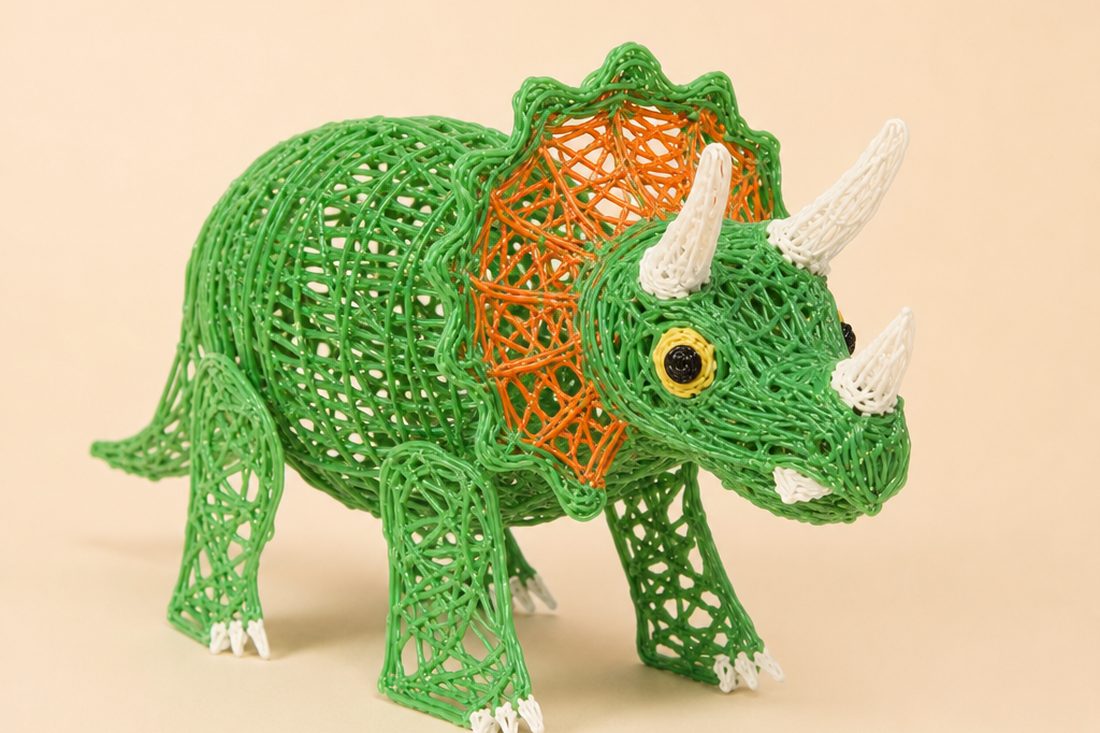
- A creation that stands in three dimensions rather than lying flat: a cube, a little house, a figure. The milestone most children reach around age 8 to 9, as our by-age guide describes.
Safety and the labels on the box
Finally, the small print. These are the terms that separate a marketing label from a tested claim, and they are worth knowing before any purchase.
- Surface temperature
- How hot the parts a child can touch actually get. The single most important number on any kids' pen spec sheet, and the first thing our safety guide teaches you to check.
- Low-temperature pen
- A pen designed around PCL so it runs cool enough for children. The phrase itself is unregulated marketing language, which is why a published, verified figure matters more than the label.
- Lab-verified
- A temperature figure measured by a laboratory rather than claimed by the marketing department. Pen'Up 3D's 35 degrees C surface is lab-verified, which is the strongest form of the claim.
- Burn threshold
- The zone, roughly 50 to 60 degrees C in sustained contact, where hot surfaces start to risk harming skin. A surface verified at 35 degrees C sits far below it, with a wide margin.
- CE marking
- The manufacturer's declaration that a product meets the European Union's safety requirements. Required for toys sold in Europe; its absence on a child's product is a red flag.
- EN71
- The European standard specifically for toy safety, covering mechanical, flammability and chemical requirements. 'EN71 tested' means the product was tested against that standard; Pen'Up 3D is CE compliant and EN71 tested.
- Supervision
- The adult presence a young maker needs, scaling down with age: alongside at 6 to 7, nearby at 8 to 9, within earshot from about 10.
Armed with the vocabulary, the decisions get easy: our how-to-choose guide turns these terms into five questions, and our comparison answers them for the pens parents actually consider.
Ready to compare? See our pick and the full table.
Back to the comparison